The rajasthan looks nothing like the map suggests. What reads as a straight line between Jaipur and Jaisalmer is really a stretch of highway that changes character every hundred kilometers - smooth four-lane tarmac one hour, a camel crossing the road the next. If you're planning a Rajasthan road trip for the first time, the gap between what you expect and what you actually encounter is where most of the stress comes from. This guide fills that gap. It covers the routes worth driving, the months’ worth avoiding, what the roads are really like, and the small decisions - fuel timing, vehicle choice, daily pacing - that separate a trip people talk about for years from one they're glad to have finished. Whether you're driving yourself or booking a private cab with driver, everything below is built from what actually happens on these roads, not what a brochure says should happen.
If you prefer a planned itinerary, explore our Rajasthan 10 days Tour Packages or choose a Royal Rajasthan Tour Package for a more comprehensive journey through the state's historic cities, forts, palaces and cultural attractions.
Why Road Trips Work Better in Rajasthan
- Lights only connect a handful of cities. Jaipur, Udaipur, Jodhpur, and Bikaner have airports; Jaisalmer's is seasonal and limited. Chittorgarh, Pushkar, Bundi, Ranthambore, and most small towns have none.
- Trains skip the small stops. Trains skip the small stops. You can’t pause your journey to explore Chand Baori in Abhaneri, enjoy a traditional lunch at a roadside dhaba near Beawar, visit local villages, or discover hidden attractions along Rajasthan’s scenic routes.
- Roads connect everything. Every city and most attractions in this guide sit on a state or national highway, so a car covers the entire circuit without a single mode change.
- You control the schedule. Early starts to beat the heat, longer halts at forts and detours to a village market - none of that works on fixed timetables.
- Driver-guides add local knowledge. A driver who knows the route also knows which dhaba to stop at and which stretch of highway gets congested near a market day.
Is Rajasthan Good for a Road Trip?
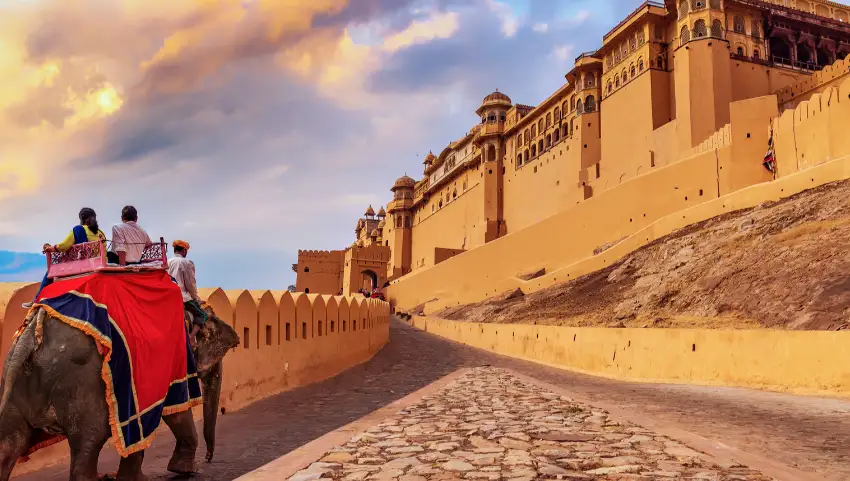
Yes, and for reasons that go beyond the obvious forts-and-palaces answer. Rajasthan is India's largest state, which means road trips here aren't a single day's drive between two cities - they're proper multi-day journeys with real variety built in. You go from the lake city calm of Udaipur to the sand dunes outside Jaisalmer to the blue-washed lanes of Jodhpur, and each leg of the drive changes the scenery as much as the destination does.
The highway network connecting the major cities is in decent shape, with National Highway stretches linking Jaipur, Ajmer, Udaipur, Jodhpur, and Jaisalmer well-maintained for long stretches. Distances between cities are long by Indian standards but manageable in a private vehicle, since you control the pace instead of working around train or bus schedules.
What makes it genuinely good, though, is that the state rewards slow travel. Roadside dhabas, small-town markets, and villages you'd never see on a flight-and-hotel itinerary all sit along these highways. A Rajasthan road trip isn't a way to reach the sights faster - its part of the sightseeing.
Some important things to consider before a Rajasthan road trip include:
- Long-distance driving between cities
- Traffic around Jaipur, Jodhpur and Udaipur
- Heat during summer
- Desert stretches around Jaisalmer
- Availability of fuel and restaurants on remote routes
- Road construction or diversions
- Limited facilities on some rural roads
- Night-driving conditions
- Time required for sightseeing and breaks
The best approach is to keep your daily schedule flexible and avoid planning too many long drives on consecutive days.
Best Rajasthan Road Trip Routes
There isn't one "correct" Rajasthan route - it depends on how many days you have and whether you're starting from Delhi, Jaipur, or flying directly into the state. That said, a handful of circuits come up again and again because they balance driving time against what you actually get to see.
The classic Golden Triangle extension (Delhi–Jaipur–Agra) works well if you're combining Rajasthan with a first India trip, since it bolts a Rajasthan leg onto an itinerary most travelers are already building. For a trip focused purely on Rajasthan, the Jaipur–Udaipur route through Ajmer and Pushkar is one of the most rewarding short circuits - you get a pilgrimage town, a lake city, and a desert-adjacent stretch of highway in under a week. See our full Jaipur to Udaipur road trip guide for a day-by-day breakdown.
If you have 10–14 days, the Western Rajasthan circuit covering Jodhpur, Jaisalmer, and Bikaner adds real desert terrain to the trip - longer drives, but the kind of empty-highway, dune-lined scenery you don't get on the eastern routes. We've written a separate western Rajasthan desert circuit guide that covers this in more depth
|
Route |
Cities Covered |
Approx. Distance |
DistanceSuggested Duration |
|---|---|---|---|
|
Golden Triangle + Rajasthan |
Delhi – Agra – Jaipur |
550–600 km |
6–7 days |
|
Classic Rajasthan Loop |
Jaipur – Pushkar – Udaipur – Jaipur |
750–800 km |
7–8 days |
|
Western Desert Circuit |
Jodhpur – Jaisalmer – Bikaner |
850–900 km |
10–12 days |
|
Grand Rajasthan Circuit |
Jaipur – Udaipur – Jodhpur – Jaisalmer – Bikaner – Jaipur |
1,400–1,500 km |
14–16 days |
|
Short Getaway |
Jaipur – Ajmer – Pushkar |
280–300 km |
2–3 days |
For travelers short on time, the Short Getaway route works as a weekend trip from Jaipur. For anyone who wants to see the state properly - palaces, desert, lakes and the drive between them - the Grand Rajasthan Circuit is the one to build a two-week holiday around. Travelers coming from major cities can also explore options such as Rajasthan tours from Delhi, Rajasthan tours from Mumbai, Rajasthan tours from Bangalore, Whichever route you pick, don't try to force two circuits into one trip; overlapping routes usually means undoing several hours of driving just to backtrack.
Best Time for a Rajasthan Road Trip?
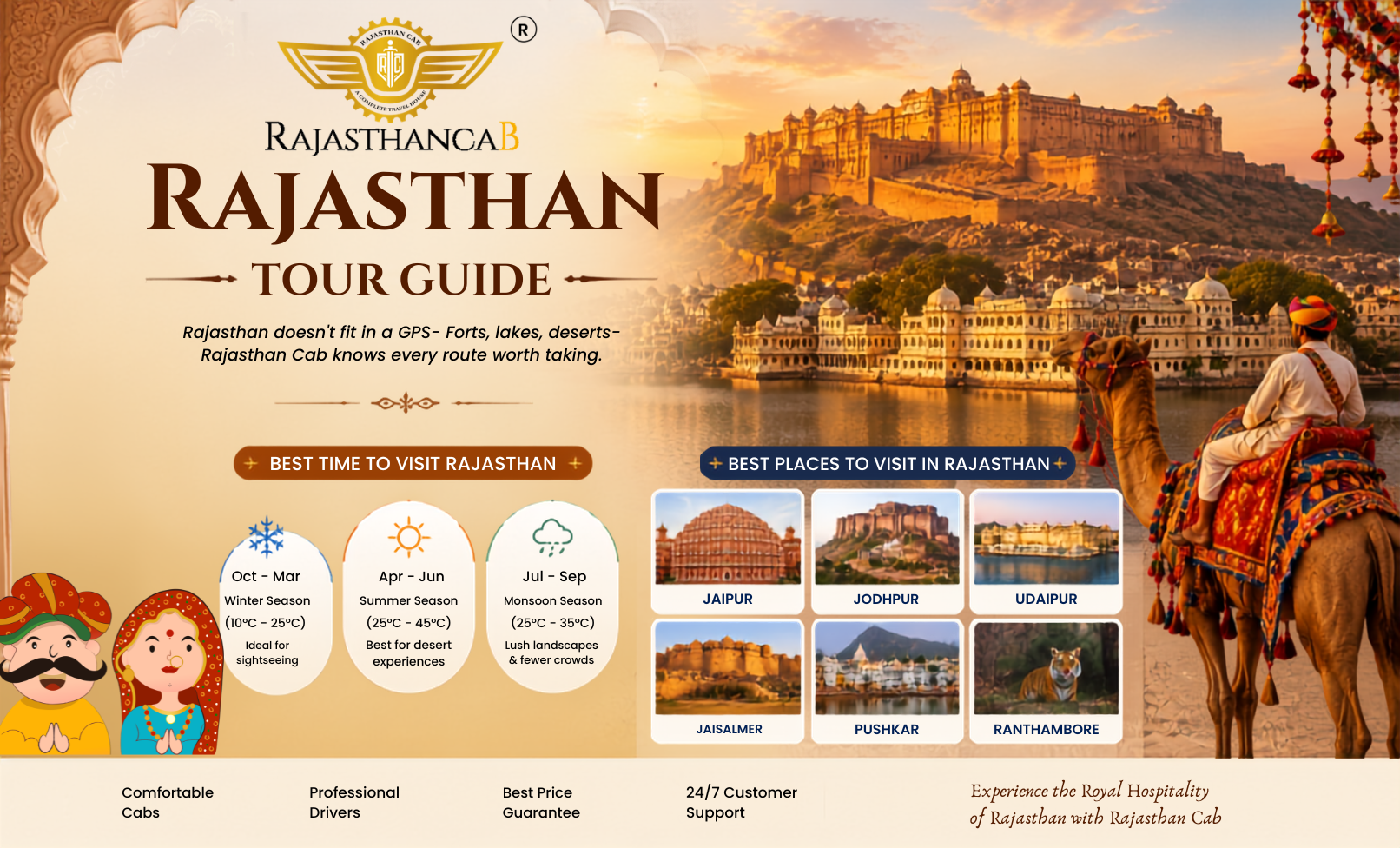
October to March - Best overall period
- Pleasant daytime weather
- Better for long drives
- Comfortable sightseeing
- Desert activities
April to June- Hot and demanding
- Very high daytime temperatures
- Start drives early
- Carry sufficient water
- Avoid unnecessary afternoon travel
July to September- Monsoon road travel
- Some areas become greener
- Weather can change quickly
- Rain may affect driving conditions
- Keep flexible travel schedules
Important tip- For a road trip, weather matters more than it does for a simple city holiday, because travellers spend several hours outdoors and on highways.
Rajasthan Road Conditions: What Should You Expect?
The major National Highways connecting Jaipur, Ajmer, Udaipur and Jodhpur are generally well-surfaced, multi-lane in sections, and fast - you can comfortably average 60–70 km/h on the better stretches. State highways linking smaller towns are narrower, often single-lane-each-way and shared with slower traffic: tractors, camel carts and local buses that stop without much warning.
Expect livestock on the road, especially near villages and around dawn or dusk. Cows, goats and the occasional camel treat the highway as shared space and local drivers navigate around them without slowing much - you should slow down more than they do. Toll booths appear on most national highway stretches, so keep small change or a FASTag-enabled vehicle handy.
Road quality also drops noticeably as you head deeper into the desert districts near Jaisalmer and Barmer, where sand drift across the tarmac is common after windy days. If you're planning a longer [Rajasthan road trip], allow extra time for slower stretches, village traffic, and unexpected stops. None of this makes the roads unsafe, but it does mean padding your travel time estimates rather than trusting a maps app's optimistic number. This is especially useful when planning a Rajasthan itinerary that covers multiple cities in one journey.
Rajasthan Road Safety Tips
Avoid unnecessary night driving
Especially on unfamiliar rural/desert routes.
Don't drive continuously for too long
Take regular breaks.
Follow speed limits
Road conditions can change quickly.
Watch for animals
Cattle and other animals may appear unexpectedly, especially outside cities.
Keep emergency numbers
Have important contacts available offline.
Carry drinking water
Especially on longer routes.
Check the vehicle before departure
Tyres, brakes, fuel, lights and AC are especially important during long trips.
Keep your phone charged
Carry a power bank.
Don't depend entirely on mobile internet
Download offline maps for long routes.
Leave buffer time
Don't plan arrival based on the minimum possible driving time.
Carry basic documents at all times
Driving license, vehicle registration, insurance and ID. Police checkpoints are routine, especially near state borders and district boundaries.
Rajasthan Road Trip: What to Carry
Essential items
- Driving licence
- Vehicle documents
- ID proof
- Phone + charger
- Power bank
- Water bottle
- Sunglasses
- Sunscreen
- Comfortable clothing
- Comfortable footwear
- Basic medicines
- Snacks
- Offline maps
- Emergency contacts
- Cash + digital payment option
For desert routes
- Extra water
- Sun protection
- Light jacket for winter evenings
- Fully charged phone
Fuel & Rest Stops on Rajasthan Roads
- Refuel before entering long stretches.
- Don't wait until the tank is nearly empty.
- Plan fuel stops between major cities.
- Take breaks every few hours.
- Choose established restaurants/rest areas for longer breaks.
Important tip: When travelling through remote areas, don't assume the next fuel station or restaurant will be just a few kilometres away.
Rajasthan Circuit Options by Trip Length
How far you can realistically drive depends on how many days you have. These are rough totals for the most common trip lengths, based on the tables above.
5-day circuit (Jaipur – Pushkar – Udaipur – Jaipur): Roughly 950–1,000 km total driving, averaging 3–4 hours a day. Comfortable pace, no long hauls, good for a first trip or a shorter holiday window.
7-day circuit (Jaipur – Jodhpur – Udaipur – Jaipur, via Ranakpur): Around 1,300–1,400 km total. One longer day (Jaipur–Jodhpur at 6 hours), the rest under 5 hours, with a rest day possible in Udaipur.
10-day circuit (Jaipur – Bikaner – Jaisalmer – Jodhpur – Udaipur – Jaipur): Close to 1,700–1,800 km total, the full western loop described in the matrix above. This is the version that needs the most careful pacing - two genuinely long driving days (Jaipur–Bikaner and Bikaner–Jaisalmer) back to back if not broken up.
14-day circuit (adds Mount Abu, Chittorgarh, and Ranthambore): Roughly 2,200–2,400 km total. This is close to a full state tour and works best when treated as two smaller loops - western desert cities, then southern hill and lake cities - joined through Udaipur rather than one continuous line.
Average Driving Speeds and How These Times Are Calculated
The driving times in every table above assume an average speed of 55–65 km/h on national highways and 40–50 km/h on state highways or approach roads into hill towns like Mount Abu. That's slower than the posted speed limits because Rajasthan's highways run through market towns, have periodic speed breakers near schools and villages, and carry a mix of trucks, tractors and local traffic that a private car has to work around. A few things that change the math on any given day:
- Town crossings - Jaipur, Jodhpur and Udaipur city traffic can add 20–30 minutes just to clear the outskirts.
- Truck traffic on NH48 and NH62 is heaviest in the early morning and late evening.
- Wedding season (November–February) brings unpredictable local traffic near smaller towns due to processions and roadblocks.
- Construction and diversions are common on stretches being upgraded to four-lane; these can add 15–20 minutes without warning.
Building in a 15% time buffer over the flat driving-time estimate is a reasonable rule of thumb for any leg over 4 hours.
Practical Driving Notes for Rajasthan Highways
- NH48 is the state's main artery, running through Jaipur, Ajmer and toward Udaipur and onward to Gujarat. It's the best-maintained highway on this list.
- NH62 connects Jodhpur, Bikaner, and Jaisalmer through desert terrain - long, straight, and light on services between towns, so plan fuel stops in advance.
- NH21 links Jaipur, Bharatpur, and Agra, and tends to see the heaviest traffic near Jaipur city limits during morning and evening hours.
- Toll plazas are frequent on national highways; a private car with driver typically has this built into the package, but self-drive travelers should carry cash or FASTag balance.
- Night driving is not recommended on the Bikaner–Jaisalmer or Jodhpur–Jaisalmer stretches - visibility drops and services thin out further after dark.
- Summer driving (April–June) adds real strain on desert routes; start early morning to avoid driving through peak afternoon heat between Jodhpur and Jaisalmer.
- Winter mornings (December–January) bring fog on NH48 and NH21 near Bharatpur and Sikar, which can add 30–45 minutes to early starts.
- Fuel stops are reliable on all major highways listed here except the desert stretches beyond Pokhran and Phalodi, where gaps between petrol pumps run longer.
Rajasthan Road Trip Distance & Travel Time
|
Route |
Approx. Distance |
Approx. Time |
|---|---|---|
|
Jaipur → Ajmer |
135 km |
2.5–3 hrs |
|
Jaipur → Jodhpur |
335 km |
6 hrs |
|
Jaipur → Udaipur |
395 km |
7 hrs |
|
Jaipur → Jaisalmer |
560 km |
9-10 hrs |
|
Jodhpur → Jaisalmer |
280-290 |
5- 6 hrs |
|
Jodhpur → Udaipur |
250-260 km |
5-6 hrs |
|
Udaipur → Mount Abu |
165-170 km |
3 hrs |
When You Trip With Family careful always
- Comfortable vehicle
- Frequent breaks
- Child-friendly stops
- Snacks and water
- Avoid overly packed itineraries
- Choose hotels with parking
- Keep emergency contacts
- Don't schedule very long drives every day
Common Road Trip Mistakes
- Trying to cover too many cities.
- Underestimating driving time.
- Driving long distances without breaks.
- Traveling without enough water.
- Ignoring weather conditions.
- Relying completely on online maps.
- Leaving with low fuel.
- Planning every day too tightly.
- Ignoring vehicle condition.
- Choosing a vehicle too small for your group.
Rajasthan Road Trip Budget
|
Expense Category |
Estimated Cost |
Notes |
|---|---|---|
|
Private Sedan with Driver |
₹10–13/km |
Usually subject to a minimum package of around 250 km/day |
|
SUV with Driver |
₹14–18/km |
Suitable for families, groups, and longer road trips |
|
Driver Allowance |
Extra |
Usually charged for overnight stays, depending on the operator |
|
Fuel – Self Drive |
Varies |
Budget separately; prices are generally close to national averages, with a modest premium in remote desert areas |
|
Toll Charges |
₹150–400/day |
Depends on the route and number of national highways used |
|
Accommodation |
₹1,500–4,000/night |
Depends on hotel category, location, and season |
|
Meals |
₹500–1,000/person/day |
Typical mid-range food budget |
|
Fort & Palace Entry Fees |
₹50–500+ |
Varies by monument and visitor category; major sites can cost more for foreign visitors |
|
2-Week Grand Circuit – Couple |
₹65,000–95,000 |
Approximate total for transport, accommodation, food, and entry fees |
Tip: A shorter Rajasthan itinerary can cost considerably less, while luxury hotels, premium vehicles, peak-season travel, and additional experiences can push the budget higher.
Best Vehicles for a Rajasthan Road Trip
Sedan -
4+1 seats - Comfortable and economical for couples or small families. Ideal for city-to-city Rajasthan trips.
SUV -
6+1 or 7+1 seats - Spacious and powerful, making it a great choice for families and small groups traveling long distances.
Tempo Traveller -
9+1 to 16+1 seats - Best for large groups, with comfortable seating and ample luggage space for Rajasthan tours.
Luxury Cars -
4+1 to 6+1 seats - Perfect for travelers seeking premium comfort, stylish interiors and a luxurious travel experience.
Urbania -
12+1 to 16+1 seats - a modern and premium option for groups, offering spacious seating, better legroom and excellent comfort on long journeys.
Final Conclusion
Rajasthan doesn't reward a rushed itinerary. Every city on this list sits hours apart, and the drive between them is often as memorable as the destination, Distance and driving time should shape your route before hotels or sightseeing lists ever do. Skip that step, and you'll spend more time behind the wheel than in front of a fort. Get it right, and the road becomes part of the trip, not just the gap between stops. Whether you're chasing the full western circuit or a shorter loop through the Golden Triangle, plan the kilometers first - everything else falls into place after that.