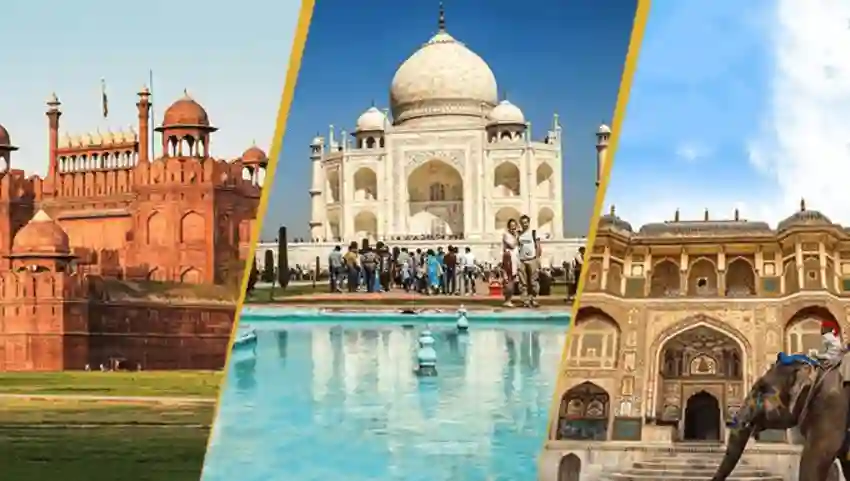

Golden Triangle Travel Guide - Delhi, Agra and Jaipur
If you are traveling to India for the first time, then the golden triangle of Delhi, Agra and Jaipur is a great places to start your journey. The three cities are home to India’s most famous landmark, royal heritage and culture. You'll begin in Delhi, where old neighbourhoods and Mughal-era monuments sit right alongside a fast-moving modern capital. From there, head to Agra to stand in front of the Taj Mahal and take in the city's Mughal-era architecture. The last stop is Jaipur, the Pink City, known for its hilltop forts, palaces and bustling bazaars. It's a route that's simple to plan and works well whether you have a week or a bit longer. This Golden Triangle travel guide walks you through distances, travel times, road routes, costs and practical tips so you can plan a trip that feels relaxed rather than rushed.
What Is the Golden Triangle of India?
The Golden Triangle is the travel circuit connecting Delhi, Agra, and Jaipur — three cities close enough together to form a rough triangle on the map, each roughly 200 to 250 kilometres from the other two. Delhi brings the political weight and food culture of a capital that's changed hands more times than most cities in the world. Agra holds the Taj Mahal, along with Agra Fort and the abandoned city of Fatehpur Sikri, all raised during the Mughal period. The Pink City, carries the Rajput half of the story — palaces, hill forts and a bazaar culture that hasn't changed much since the 1700s.
Together, these three cities cover close to a thousand years of history without needing long flights or overnight trains between stops. That's really why the route works as well as it does: Mughal architecture, Rajput heritage and a modern capital, all connected by roads short enough to cover in half a day. It's become the standard entry point to India because it delivers a lot in a short amount of time without asking travellers to sacrifice comfort to get there.
Golden Triangle Travel Guide
This guide walks through each city on the circuit — what to see, where to eat, what's worth shopping for — along with the practical planning pieces: distances between cities, how many days you actually need, the best months to go, how to get around, and what the whole trip tends to cost. If you're short on time, skip ahead to the itinerary section for a day-by-day plan. If you're still deciding whether this trip is worth it, keep reading from here.
One thing worth saying upfront: the Golden Triangle isn't a checklist to rush through in the fewest nights possible. Each city has its own pace. Delhi rewards a slower walk through Old Delhi's lanes. Agra is really a half-day city built around one monument, so there's no need to overbook it. Jaipur has enough forts, temples, and markets to fill three full days if you let it. The itinerary further down balances all three properly instead of squeezing everything into a weekend.
1. Delhi The Nation's Capital
Delhi is where most Golden Triangle trips begin and end, since it has India's busiest international airport. Give it at least a day and a half — one day for Old Delhi, half a day for the New Delhi side.
Places to visit in Delhi
Start your Delhi tour with Old Delhi with the Red Fort, the sandstone fort Shah Jahan built as his seat of power, and walk from there into Chandni Chowk, the market lane that's been running since the 1600s. Jama Masjid sits close by — climb the southern minaret for a rooftop view over Old Delhi's rooftops and pigeons. On the New Delhi side, Humayun's Tomb is worth the visit on its own; it was the design template for the Taj Mahal decades later, and it's far quieter. Qutub Minar, India Gate, the Lotus Temple, and Akshardham round out a full day if you have the time. Akshardham in particular needs a few hours, so plan it as a standalone stop rather than an add-on.
Food in Delhi
Old Delhi's food lanes are the real draw — Karim's near Jama Masjid for Mughlai kebabs and curries, Paranthe Wali Gali for stuffed parathas and roadside stalls for chaat, jalebi and kulfi. In the newer parts of the city, Khan Market and Connaught Place have everything from Punjabi dhabas to fine dining. If you only eat street food once on this trip, do it in Old Delhi.
Shopping in Delhi
Chandni Chowk covers everything from spices and fabric to jewellery, sold from shops that have run in the same family for generations. Dilli Haat is the easier option for handicrafts from across India under one roof, with fixed prices if you'd rather skip the bargaining. Janpath is the spot for clothes, bags, and souvenirs at street prices — expect to negotiate.
Where to stay in Delhi - The best area depends on your budget, sightseeing plans and preferred atmosphere.
|
Area |
Hotels |
Approx.price/ per night |
|---|---|---|
|
Connaught Place |
Radisson Blu Marina Hotel, Delhi |
₹10,000–₹14,000 |
|
Connaught Place |
The Hans, New Delhi |
₹6,000–₹9,000 |
|
Near Aerocity |
The Umrao |
₹8,000–₹12,000 |
|
Aerocity |
Novotel New Delhi |
₹12,000–₹15,000 |
|
Aerocity |
ibis New Delhi Aerocity |
₹9,000–₹13,000 |
|
Aerocity |
Lemon Tree Premier, Delhi Airport |
₹8,000–₹12,000 |
|
Old Delhi |
Hotel Tara Palace Chandni Chowk |
₹2,500–₹4,500 |
|
Connaught Place |
Hotel Bright |
₹7,000–₹10,000 |
|
Connaught Place |
Hotel Alka Classic |
₹5,000–₹7,000 |
|
Karol Bagh |
Hotel Emperor Palms |
₹3,000–₹5,000 |
|
Paharganj |
Hotel Ajanta |
₹2,000–₹4,000 |
|
Paharganj |
Hotel Amax Inn |
₹1,500–₹3,000 |
|
Paharganj |
Hotel Sun International |
₹1,500–₹2,500 |
|
Paharganj |
Hotel Delhi Darshan Dx |
₹1,000–₹2,000 |
2. Agra the Taj City
Agra is built almost entirely around one monument, and that's fine — the Taj Mahal earns it. Most visitors spend one full day here, sometimes stretching into a second morning for Fatehpur Sikri.
Places to visit in Agra
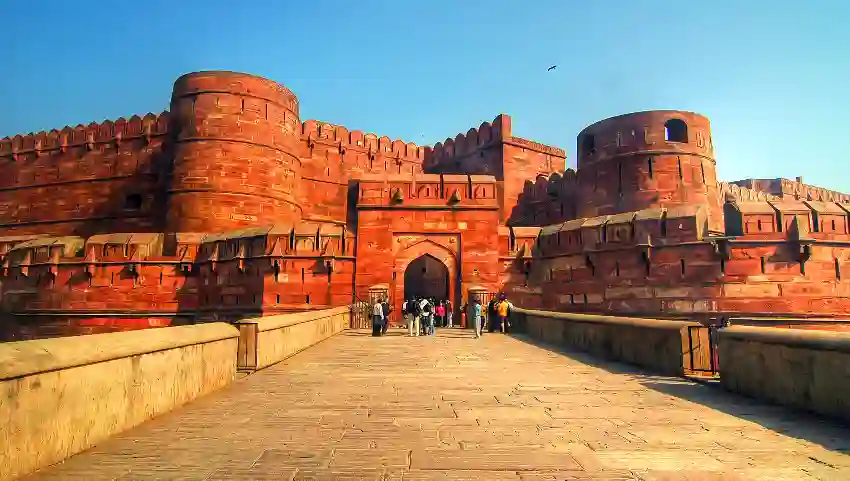
The Taj Mahal comes first, and sunrise is worth the early start — the light on white marble at 6 am is nothing like the crowded midday version. Agra Fort, a short drive away, gives you the view Shah Jahan had of his own tomb from the room where he was held under house arrest by his son. Fatehpur Sikri, about 40 km outside the city, is a red sandstone capital that was abandoned after just 15 years due to water shortages — it's one of the better-preserved Mughal sites and worth the half-day detour if you're not pressed for time.
Food in Agra
Agra's specialty is petha, a translucent sweet made from ash gourd — Panchhi Petha is the name most locals point you toward. For meals, Pinch of Spice and Peshawri (at the ITC Mughal) do Mughlai food well if you want something more than a quick bite between monuments.
Shopping in Agra
Agra is known for marble inlay work — the same pietra dura technique used on the Taj Mahal itself, still practiced by artisan families in the city. Leather goods and carpets are the other two things worth browsing, though it's worth checking a shop's reputation before buying anything expensive, since tourist-facing marble shops vary a lot in quality and pricing.
Where to stay in Agra - The best area depends on your budget, sightseeing plans and preferred atmosphere.
|
Area |
Hotel Name |
Approx.price/ per night |
|---|---|---|
|
Tajganj / Western Gate |
Hotel Sidhartha Agra |
₹1,000–₹2,500 |
|
Tajganj |
Hotel Saniya Palace Inn |
₹1,000–₹2,500 |
|
Fatehabad Road |
Taj Heritage |
₹1,000–₹1,500 |
|
Taj Nagri Phase II |
The Light House |
₹1,000–₹3,000 |
|
Taj East Gate Road |
Hotel Taj Resorts |
₹3,000–₹4,500 |
|
Taj Nagri Phase I |
The Retreat |
₹1,500–₹4,000 |
|
Fatehabad Road |
Royale Residency |
₹2,000–₹4,000 |
|
Fatehabad Road |
The Taj Vilas |
₹3,000–₹4,500 |
|
Agra Cantt |
Grand Hotel |
₹2,500–₹6,000 |
|
Rakabganj |
Imperial Hotel |
₹1,000–₹4,000 |
3. Jaipur the Pink City
Jaipur is where this guide has the most to say, partly because it's home base and partly because the city genuinely has enough to fill three full days without repeating yourself.
Places to visit in Jaipur
Jaipur's well-known sites highlight its colorful architecture, spiritual attractiveness, and royal legacy. Jaipur sightseeing tour start from Amber Fort, 11 km from the city, rises above Maota Lake and is home to the magnificent Sheesh Mahal. In the old city, City Palace offers a glimpse into Jaipur’s royal past, the famous Hawa Mahal, with its 953 windows, is perfect for street-side photographs and selfie's. Nearby, Jantar Mantar features remarkable astronomical instruments. Explore the historic Albert Hall Museum and seek blessings at Govind Dev Ji Temple and Birla Mandir. Finish your tour at Nahargarh Fort, where the sunset paints beautiful views across Jaipur’s rooftops.
Food in Jaipur
Jaipur’s food scene is a delicious Taste of Rajasthan, with dal baati churma, gatte ki sabzi and ker sangri taking centre stage. Try the famous (LMB) in the old city or enjoy a traditional dining experience at Chokhi Dhani. Jaipur is equally loved for its pyaz kachori, Daal kachori and spicy street chaat. Don’t miss the iconic Ghewar, especially during Teej, Gangour and Rakhi this sweet become a local favourite.
Shopping in Jaipur
Jaipur's top shopping spots -Johari Bazaar for jewellery, kundan, and gemstones, Bapu Bazaar and Nehru Bazaar for block-printed fabric, bandhani and mojari footwear, Tripolia Bazaar for lac bangles and brassware, Chandpole Bazaar for marble carvings and Sanganer/Bagru villages for authentic hand block printing. Amber Road has dedicated blue pottery outlets. One practical tip: bargaining is standard in Johari and Bapu Bazaar start at half the quoted price. Fixed-price stores like government emporiums, try Anokhi or Amrapali instead.
Where to stay in Jaipur –
|
Area |
Hotel Name |
Approx.price/ per night |
|---|---|---|
|
MI Road / Sindhi Camp |
Moustache Jaipur |
₹1,000–₹2,500 |
|
Bani Park |
Jaipur Inn |
₹2,000–₹3,500 |
|
Bani Park |
WelcomHeritage Traditional Haveli |
₹2,500–₹5,000 |
|
Bani Park |
Umaid Bhawan-A Royal Heritage Style Boutique Hotel |
₹3,500–₹6,000 |
|
Gopalbari |
Hotel Metro Inn |
₹2,500–₹5,000 |
|
Bani Park |
Hotel Jaipur Central |
₹3,000–₹5,500 |
|
Jawahar Nagar |
The Fern Residency, Jaipur |
₹4,000–₹7,000 |
|
Moti Doongari |
Rajasthan Palace - A Heritage Boutique |
₹4,000–₹7,000 |
|
Amer Road |
Club Mahindra Resort |
₹4,000–₹8,000 |
|
Khatipura |
Royal Heritage Haveli |
₹7,000–₹10,000 |
|
C-Scheme |
Rajmahal Palace RAAS Jaipur |
₹10,000–₹15,000 |
Price note - Hotel prices are approximate and may be lower or higher depending on travel dates, season, weekends, festivals, room category, availability and special offers.
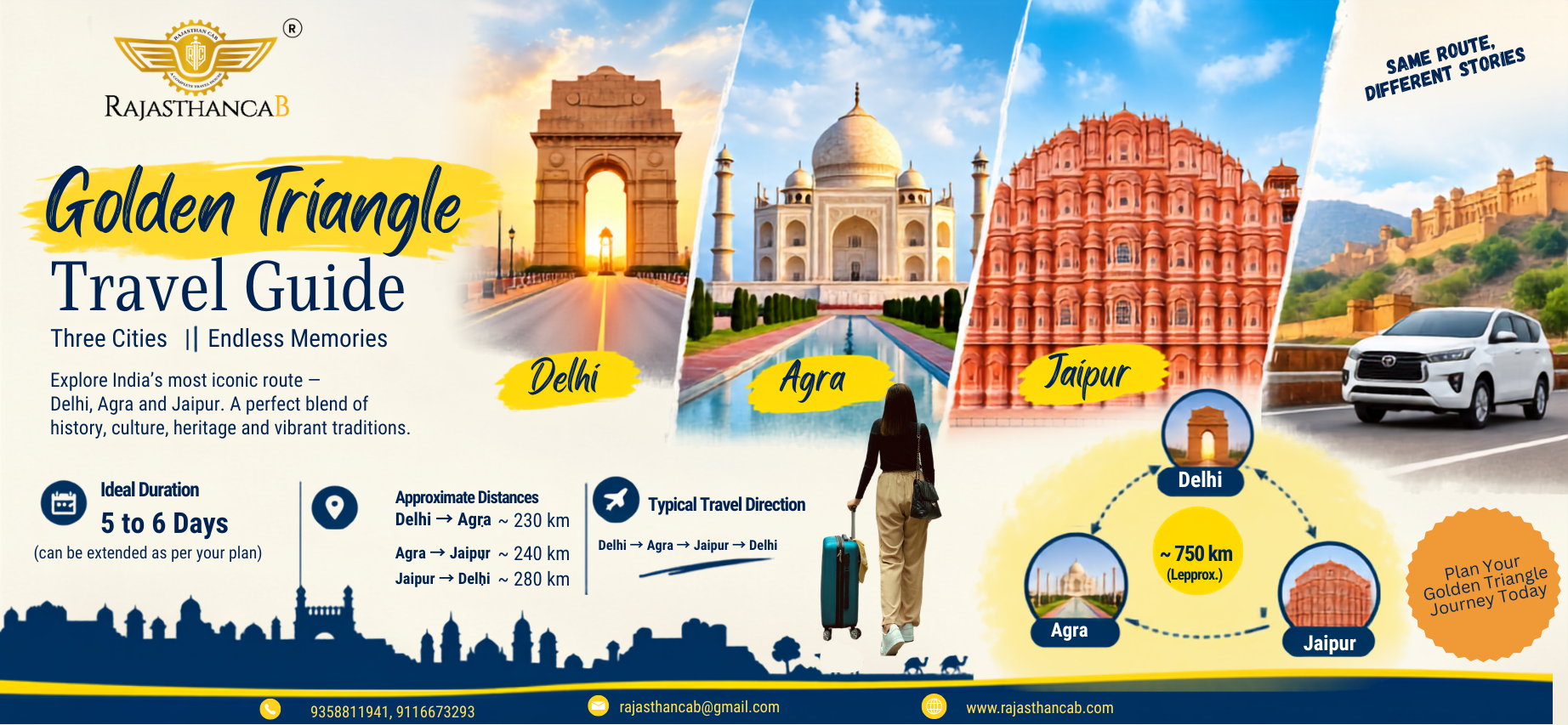
Approximate Distances and Typical Travel Direction
Here's how the three cities line up on the road: Here’s a clean, detailed table format that works well for a travel
|
Route |
Approx. Distance |
Typical Travel Time |
Main Route / Highway |
Travel Direction |
||||
|---|---|---|---|---|---|---|---|---|
|
Delhi → Agra |
230 km |
3.5–4 hours |
Yamuna Expressway |
Southeast |
||||
|
Agra → Jaipur |
240 km |
4.5–5 hours |
NH21 & Bharatpur–Dausa Route |
West |
||||
|
Jaipur → Delhi |
280 km |
|
NH48 |
|
This classic route connects India’s three iconic destinations in a convenient loop, covering Delhi’s heritage, Agra’s Mughal architecture and Jaipur’s royal Rajasthani culture with minimal backtracking
Simple route map
Delhi (start) → drive 3.5–4 hrs → Agra (Taj Mahal, Agra Fort, Fatehpur Sikri) → drive 4.5–5 hrs → Jaipur (Amber Fort, City Palace, Hawa Mahal) → drive 5–5.5 hrs → Delhi (return/departure)
Total driving time for the full loop comes to roughly 13 to 15 hours, spread across the days you're on the road rather than done in one stretch.
How Many Days Are Enough for the Golden Triangle?
This depends on how you like to travel, but here's a rough breakdown:
- 4 days / 3 nights — the minimum for a proper trip. One night each in Agra and Jaipur, with Delhi covered on arrival and departure days. It's tight, and you'll skip Fatehpur Sikri and most of Delhi's Old City.
- 6 days / 5 nights — the comfortable version. Two nights in Delhi, one in Agra, two in Jaipur. This is enough time to see everything listed above without feeling rushed.
- 8 to 10 days — the leisurely version, adding a stop like Ranthambore for a tiger safari or Pushkar for a day, without cutting into time in the three main cities.
If this is a first trip to India and you're not sure how you'll handle the pace, six days is the number to build around. It gives each city its due without turning the trip into a series of transit days.
Best Time to Visit the Golden Triangle
Best time to visit the Golden Triangle is October to March, when Delhi, Agra and Jaipur have pleasant weather for sightseeing. Winter offers comfortable days for exploring forts, palaces and markets. October–November brings festive charm, while December–February is best for cooler weather. Avoid peak summer heat from April to June.
The best time to visit the Golden Triangle is October to March, with pleasant temperatures around 10°C–25°C. December and January are cooler, especially mornings and evenings. Winter offers comfortable days for exploring forts, palaces and markets. Summer from April to June, can reach 40°C–45°C, making sightseeing uncomfortable. Monsoon brings humidity and occasional rainfall across the region.
How to Travel the Golden Triangle
The Golden Triangle—Delhi, Agra and Jaipur—is easy to explore by road, train or private taxi.
Travel By Train
Trains are a convenient option between major cities, particularly for budget-conscious travellers. Buses are also available, fast and well-connected services make trains a convenient choice for travellers.
|
Route |
Train |
Approx. Journey Time |
|---|---|---|
|
Delhi → Agra |
Gatimaan Express |
~1 hr 40 min |
|
Delhi → Agra |
Taj Express |
~2.5–3 hrs |
|
Agra → Jaipur |
Shatabdi Express |
~4 hrs |
|
Agra → Jaipur |
Intercity Express |
~4–5 hrs |
|
Jaipur → Delhi |
Ajmer Shatabdi |
~4–5 hrs |
|
|
Double Decker Express |
~4.5–5 hrs |
Travel by Cab / Taxi
Hire Your Desired Car in Jaipur with a driver is the most practical way to cover this route and it's what most travellers end up choosing once they compare the options. A car avoids that break entirely, lets you stop at places like Fatehpur Sikri or Abhaneri along the way, and means you're not tied to fixed departure times.
Rajasthan Cab runs this exact circuit regularly out of Jaipur, with sedans, SUVs, Tempo Traveller and Force Urbania depending on group size, and drivers who know the route well enough to time the Taj Mahal visit around the light and the crowds rather than just the clock. For groups larger than six, a tempo traveller is usually the more comfortable option than two separate cars.
A Proper Golden Triangle Itinerary (6 Days / 5 Nights)
Day 1 — Arrive Delhi
Land and settle into the hotel, and if there's time in the evening, take a short walk around Connaught Place or India Gate to shake off the flight.
Day 2 — Delhi
Full day covering Old Delhi in the morning — Red Fort, Jama Masjid, Chandni Chowk — and New Delhi in the afternoon, with Humayun's Tomb and Qutub Minar. Drive to Agra in the evening, or early the next morning if you'd rather not drive after dark.
Day 3 — Agra
Sunrise at the Taj Mahal, followed by Agra Fort mid-morning. After lunch, drive to Fatehpur Sikri for a couple of hours, then continue on to Jaipur, arriving by evening.
Day 4 — Jaipur
Morning at Amber Fort, followed by City Palace, Jantar Mantar, and Hawa Mahal in the walled city. Evening free for Bapu Bazaar or dinner at Chokhi Dhani.
Day 5 — Jaipur
A slower day — Nahargarh Fort for the view, Albert Hall Museum, and time in Johari Bazaar for jewellery and textiles. This is also the day to add an excursion like Abhaneri stepwell if the pace has felt rushed so far.
Day 6 — Return to Delhi
Drive back to Delhi (5 to 5.5 hours), timed around your onward flight.
5 days Recommended - 2 days Delhi + 1 day Agra + 2 days Jaipur if you want to cover the major highlights of Delhi, Agra and Jaipur comfortably. If you prefer a slower pace with more cultural experiences, shopping and local sightseeing, 6–7 days is even better.
How Much Does a Golden Triangle Tour Cost?
Costs vary a fair amount depending on hotel category, vehicle type and whether you're travelling solo, as a couple, or in a group, but here's a realistic range for a 6-day trip:
- Car and driver (sedan, AC, fuel, driver allowance, toll and parking included): roughly ₹12,000 to ₹18,000 for the full circuit, depending on the vehicle and season.
- Hotels: budget 3-star runs about ₹2,000 to ₹3,500 per night per room; mid-range 4-star around ₹4,500 to ₹7,000; heritage or 5-star properties (and Agra/Jaipur have some genuinely special ones) start around ₹10,000 and go well beyond that.
- Monument entry fees: the Taj Mahal alone runs about ₹1,300 for foreign visitors (plus extra for the mausoleum itself), with Agra Fort, Fatehpur Sikri, Amber Fort and City Palace each in the ₹200 to ₹1,000 range depending on nationality. Budget roughly ₹3,000 to ₹4,000 per person for all major monuments across the trip.
- Guides: local guides at major sites typically charge ₹500 to ₹1,500 per monument, or a fixed daily rate if booked for the full circuit.
- Food: ₹1,000 to ₹2,500 per day per person, depending on whether you're eating street food or sit-down restaurants.
Put together, a mid-range 6-day trip for two people, covering transport, 4-star hotels, monuments and food, tends to land somewhere between ₹65,000 and ₹1,00,000 total, excluding international flights. Budget travellers can bring that down significantly by choosing simpler hotels and skipping guides at every stop.
Note: For the most accurate price based on your travel dates, hotel and transport preferences, you can call us or contact our team to confirm the latest package cost of golden triangle.
Golden Triangle Travel Tips
A few things worth knowing before you go:
- The Taj Mahal is closed on Fridays. Plan your Agra day around this — it catches a surprising number of first-time visitors off guard.
- Dress modestly at religious sites and forts; shoulders and knees covered is the general rule, and shoes come off before entering some temples.
- Carry small denomination notes for entry fees, tips and street food — change is often in short supply at ticket counters.
- Bargaining is expected in markets like Chandni Chowk, Bapu Bazaar, and Johari Bazaar, but not in fixed-price government emporiums or malls.
- Camera fees at monuments are separate from entry tickets in some cases and video cameras usually cost extra — check at the counter before walking in.
- Keep some buffer time built into the Agra day specifically, since security lines at the Taj Mahal can run long during peak winter months.
- Tip drivers and guides at the end of the trip rather than daily; ₹300 to ₹500 per day for a driver and a similar range for guides is standard.
- Avoid unofficial guides who approach you directly outside monuments — book through your hotel or driver instead.
Possible Excursions to Add to the Golden Triangle Itinerary
If you have extra days to spare, a few detours are worth building into the route rather than treating this as a strict three-city trip:
Ranthambore National Park - sits about 3.5 to 4 hours 180 to 200 km distance from Jaipur and is one of the better places in India for a tiger safari, with sightings common enough that most two-day visits get at least one. It fits naturally as a two-night add-on after Jaipur.
Chand Baori, the stepwell at Abhaneri (2.5 to 3 hour), 95 to 100 km form jaipur sits almost exactly between Agra and Jaipur, close enough to the highway that it works as a one-hour stop on the drive between the two cities rather than a separate trip.
Pushkar and Ajmer work well as a two-day extension from Jaipur (135 km) 2.5 to 3 hour, particularly if your visit lines up with the Pushkar Camel Fair in the second half of the year — worth checking dates in advance since it draws large crowds.
Bharatpur Bird Sanctuary, close to Agra (54 to 60 km) taking 1 to 2 hour, is a good half-day stop for anyone interested in birdwatching, with the widest variety of species during the winter migration months.
Mathura and Vrindavan, also near Agra (55 to 60 km) taking 1 to 1.5 hour, add a religious and cultural layer to the trip for travellers interested in Krishna-related pilgrimage sites, and can be done as a half-day detour on the way to or from Agra.
None of these are necessary to call the Golden Triangle complete, but they turn a good trip into a fuller picture of what this part of India actually looks like beyond the three main stops.
Final Conclusion
The Golden Triangle isn't just a route between Delhi, Agra and Jaipur —it's a chance to pack centuries of history, architecture and culture into a single trip. Delhi opens things up with its old monuments and crowded bazaars, Agra hands you the Taj Mahal and Jaipur closes it out with forts, palaces and markets that each carry their own story. Get the itinerary right and you'll still have time left over for good food, some shopping, and a few local experiences instead of rushing from one site to the next. If you've got extra days to spare, it's worth tacking on Ranthambore for a shot at spotting a tiger, Chand Baori's dizzying stepwell, the twin towns of Pushkar and Ajmer, Bharatpur's bird sanctuary, or Mathura and Vrindavan for a slower, more spiritual stretch of the trip.